Showing posts with label construction. Show all posts

Wednesday, 28 September 2016

Scope of the Valuation Methods in Spain (II)

Scope of the Different Methods for the Valuation of Properties in Spain (II)

Spanish Order ECO/805/2003


The rules established by Spanish Order ECO/805/2003 for the valuation of  real estate apply whenever the appraised value is used for any of the following purposes:
  • mortgage warranties for loans that are or will be an integral part of the portfolio issued by the kind of entities described in the R. D. 685/1982, developing aspects of the Law 2/1981, about regulation of the Mortgage Market in Spain
  • determination of a fair value for the purposes of the registration and second valuation standard in the Accountability Plan of insurance and reinsurance companies (R.D. 1317/2008), and determination of the valuation of assets for the purposes of the Law 20/2015, about management and supervision of insurance and reinsurance companies in Spain
  • valuation of the assets of the real estate collective investment institutions regulated by the Spanish Royal Decree 1309/2005, approving the Regulation of the Law 35/2003, about Collective Investment Institutions in Spain
  • valuation of the property assets of Pension Funds (R.D. 304/2004, approving the Pension Fund Regulation in Spain).

If the purpose of the valuation is among those listed above, the assessment can be made by the following technical methods:
  • Method of the Cost: for the valuation of all types of buildings and building elements, whether in project phase, under construction, already finished or during a rehabilitation process
  • Method of Comparison: for the valuation of all types of properties, provided that the requirements set out in Article 21 are met
  • Method of Income Update: for the valuation of all kinds of properties susceptible to produce income, provided the requirements set out in Article 25 are met
  • Residual Dynamic Method: for the valuation of urban or developable land, built or not, and of buildings in design phase, construction phase or during a rehabilitation process, no matter if the works are paralyzed
  • Residual Static Method: for the valuation of plots and buildings during a rehabilitation process where the construction or rehabilitation works are entitled to begin within a period not exceeding one year, and also built plots.

Valuation Reports in Spain

Monday, 21 September 2015

Rules for the Valuation of Properties According ECO/805/2003 (VII)

Valuation Rules According ECO/805/2003 (VII)

General Warnings


According Spanish ECO/805/2003, we find a ‘warning case’ whenever we have doubts about any of the data used in the calculation of the technical values. At a minimum, we should consider the following cases:
  • when there is a discrepancy between the physical reality of the property and its description in the Property Registry or the Cadastre, if such discrepancy does not lead to doubt about the identification and do not affect the calculated values
  • when the property is not in accordance with the applicable urban planning, unless some conditioning have been stated or it was not possible to verify the system of protection of the architectural heritage
  • when the valued property is subject to expropriation or was constructed on the basis of a license or an administrative authorization containing conditions, which if not met, may result in changes to the certified value
  • when the valuation has been calculated using different methods than those stated in Spanish Order ECO/805/2003
  • when the maximum legal value was calculated in absence of some of the required documents
  • when the valuation was calculated in absence of the necessary documents to calculate cash flows
  • in rural properties, when the valuation was calculated in absence of the cadastral documentation or the documents describing the operating system
  • in the valuation of buildings under construction or rehabilitation for the finished building hypothesis, when the valuation was calculated in absence of a complete set of the Construction Documents already endorsed by the Architects’ Association, or the final certification of the performed work, or the Building Contract, or the Schedule of Construction Costs
  • in buildings whose main use is housing, when the valuation was calculated in absence of the document attesting the expedition of the decennial insurance for property damage
  • in buildings in horizontal property regime or building elements different than houses or garages, when the valuation was calculated in absence of the statutes of the homeowners, an equivalent document or a Certificate by the community manager, certifying the limitations of use or other circumstances able to affect the value
  • when the Cadastral Reference does not exist or can not be known by the means provided in the revised text of the Law on Real Estate Cadastre, or through the Virtual Office of the Cadastre
  • in properties located abroad, when the valuation was calculated in the absence of all the documentation that, in accordance with the rules applicable in the country where the property is located, may have some influence on the value of the property.

Valuation Reports in Spain

Wednesday, 16 September 2015

Rules for the Valuation of Properties According ECO/805/2003 (V)

Valuation Rules According ECO/805/2003 (V)

Statement of the Values. Checks. Land Area. Mortgage Value. Intermediate Valuation.


When valuing a Real Estate in Spain, the values should be stated in a report and, where appropriate, a Certificate of Valuation.

Minimum Checks

The valuation of a property requires to perform all necessary checks to know the characteristics and the actual condition. Among the checks that should be performed, the following ones should always be included:
  • physical identification of the property, through its location and visual inspection, checking if its floor area and other characteristics match the description
  • identifying all visible servitudes
  • conservation status or condition
  • occupancy status
  • use or exploitation intended for the property
  • public protection regime, if it’s about housing
  • architectural heritage protection regime
  • agreement of the property with all applicable urban planning regulations
  • where applicable, availability of right to the valued urban use.

Land Area

In order to calculate the value of a land or a country estate, the area to consider should be checked by the appraiser. If this testing is not feasible, the appraiser should use the lowest value between the Registry Area and the Cadastral Area.

Definition of Mortgage Value (VH)

The Mortgage Value or VH (‘Valor Hipotecario’, in Spanish) is defined as the value of the property as determined by a prudent valuation, taking into account all market conditions, the use at the time of the valuation and any possible alternative uses.

Definition of Intermediate Valuation

The Intermediate Valuation of a construction work is any of the valuations that are issued after the initial valuation and during the construction or rehabilitation process of a building or an element of a building. The Intermediate Valuation reflects the progress of the works and the percentage of work performed, but its issue does not involve the updating of the values ​​contained in the initial valuation.
Valuation Report

Tuesday, 23 December 2014

Rules for the Valuation of Properties According ECO/805/2003 (II)

Valuation Rules According ECO/805/2003 (II)

Valuation Entity. Updating. Rehabilitation. Antiquity.


In Spain, the Valuation Entities are:
  • in general, Valuation Companies approved and registered in the Special Registry of the Banco de España
  • for valuations aiming at the mortgage warranty of loans that are or will be part of the coverage of mortgage titles issued by institutions, developers and builders described by the Spanish Royal Decree 685/1982, the Valuation Services of loan entities approved and registered in the Special Registry of the Banco de España.

Updating

Updating a valuation is to review a valuation issued by a Valuation Entity before two years from the date of issuance, or three if the purpose of the valuation is to cover the technical provisions of insurance companies required by the Spanish Royal Decree 2486/1998. The updating can modify the warnings, the conditions or any of the values.

Rehabilitation

A building in rehabilitation is a building, or an element of a building, which has started some works that meet the following requirements:
  • they are being performed under a building permit
  • they are being performed according to a set of Construction Documents endorsed by the Architects' Association
  • they affect at least a 50 per cent of the floor area, involving the improvement of the living conditions (replacing, restoring or upgrading constructive elements or installations) or a substantial alteration of the morphology of the building
  • the construction cost reaches, at least, a 50 per cent of the gross replacement value of the building, excluding the value of the land.

In the valuation of an entire building in which a partial reform is being performed, the definition of rehabilitation may be applied to the affected part if the works cover, at least, a complete storey.

Antiquity

For the correct interpretation of the Order ECO/805/2003, the antiquity is the number of years between the date of construction or complete rehabilitation of the property and the valuation date.
Valuation of Buildings


Architect Daniel Trujillano

Thursday, 11 December 2014

Value Module M for Cadastral Valuations in Spain

Module M for Determining the Value of Properties in Spain

M, MBR and MBC Modules


The revised text of the Spanish Law of Cadastre (R.D.L. 1/2004) provides that the determination of the Cadastral Value should take into account the market circumstances and values, which cannot be exceeded. One of the instruments that allow the correlation between Cadastral Value and Market Value is the Value Module M. This module must collect the variations experimented over time by the Market Value of the urban real estate, according to the market analysis performed by the General Directorate of Cadastre.

Current Value of Module M

The value of the Module M that is considered current is still the one set by the Order EHA/1213/2005, which established 1,000 Euros per square meter.

Current Values of MBR and MBC Modules

The application of factors for the diversification of the land and the construction results in the MBR and MBC Modules. The Circular 01.04/14/P of the General Directorate of Cadastre established, for the year 2014, Impact Values ranging from 25 Euros per square meter, corresponding to the MBR-6 and MBR-7, to 3,886 Euros per square meter, corresponding to the MBR-1. The current values for the module MBC were determined in Circular 01.04/08, which assigned a construction value ranging between 400 Euros per square meter, corresponding to MBC-7, to 700 Euros per square meter, corresponding to MBC-1. The MBR and MBC Modules apply to Statement of Values affecting all the urban properties of the municipality, and also to any subsequent partial Statement.
Valuation of Buildings in Spain


Architect Daniel Trujillano
http://www.arquitectotrujillano.com/valuation/home.html
Valuation Reports for Buildings in Spain

Monday, 24 November 2014

The General Review of Building Works (IV)

General Review in Spain (IV)

Construction Manager. Builder in Charge.


In Spain, the Construction Manager ('Jefe de obra' in Spanish) is the person representing the builder. The Spanish Law on Construction Planning requires the Construction Manager is a technician who, by his qualifications or experience, have an adequate capacity for the type of the work to perform. In small construction companies, it's frequent that the Construction Manager has no qualifications at all, so his working experience will have to be enough to provide all the knowledge required to perform his functions. In medium and big companies, the Construction Manager use to have some technical degree, normally Technical Architect, but he can also be an Architect or Engineer. The basic functions of the Construction Manager are:
  • supervising the performance of the works, in direct contact with the Builder in Charge
  • controlling the costs
  • planning time frames
  • acting as the builder representative at meetings with subcontractors
  • representing the construction company at meetings with the Professional Managers and the Developer
  • reporting on the progress of works
  • designating a responsible agent for safety and health issues on behalf of the company
  • organizing the purchase of materials and the hiring of trades
  • submitting Certificates of Work, for the consideration of the Professional Managers
  • reporting any anomaly or incident to the Professional Managers, if they arise and can cause problems for the right performance of the works
  • taking measures to prevent the incursion of outsiders on site
  • taking measures to prevent incidents that may detriment the safety of the work.

The Builder in Charge

The functions of the Builder in Charge ('Encargado' in Spanish) are:
  • receiving materials and signing invoices, without technical control
  • controlling the performance and order of the different jobs
  • controlling all the trades, avoiding interference between them
  • controlling stockpiles
  • controlling machines and tools.

Architecture Services for Building Projects


Architect Daniel Trujillano

Sunday, 23 November 2014

Info03. Legalization of Building Works in Andalusia


Architect Daniel Trujillano

The General Review of Building Works (III)

General Review in Spain (III)

Coordinator for Safety and Health. Types of Builders.


If the works of a building project involve more than one company or freelancer, the developer must designate a Coordinator for Safety and Health during the performance of the works. According to the Spanish LOE (Law on Construction Planning), the enabling qualifications to serve as a Coordinator for Safety and Health in building projects are:
  • Architect
  • Technical Architect
  • Engineer
  • Technical Engineer.

The Coordinator for Safety and Health shall perform the following functions:
  • coordinating the implementation of the general principles of prevention and safety in making technical decisions, in order to plan the work to develop
  • coordinating the activities of the work, in order to ensure that contractors, subcontractors and freelancers apply the principles of preventive action in a consistent and responsible manner
  • approving the Safety and Health Plan prepared by the builder and, when applicable, the modifications introduced therein
  • organizing business activities
  • coordinating actions to control the correct application of the working methods
  • taking measures to limit the access to the building works.

When the building works are not very complex, the developer tends to shift the appointment of the Coordinator to any of the professionals in the Professional Management, either the Director of the Works or the Director of the Performance of the Works.

The Builder

Construction firms can respond to the following classification:
  • small companies: they have little business infrastructure and use to outsource some services
  • medium companies: they have some technician workforce, which use to act as representative on site
  • big companies: they have complex charts composed of delegates, team leaders, production managers, etc.

Small companies use to pursue reform projects for homes, shops and public buildings, and new-building projects for single houses and small housing developments. Medium companies access to more types of works, through tender or auction. Big companies reach high budget building projects.
Architecture Services for Building Projects


Architect Daniel Trujillano

Wednesday, 19 November 2014

The General Review of Building Works (II)

General Review in Spain (II)

Professional Management. Director of the Works and Director of the Performance.


In Spain, the Professional Management of the Works is formed by the Director of the Works and the Director of the Performance of the Works. The mission of the Professional Management is leading the development of the works in accordance with the Construction Documents, the Building Permit, other mandatory authorizations and the conditions of the Contract.

Obligations of the Director of the Works

The Director of the Works must meet the following requirements:
  • to be in possession of the enabling degree, and meet the necessary conditions for the exercise of his profession
  • to verify the stakeout of the designed foundation and establish its suitability to the Geotechnical characteristics of the ground
  • to verify the stakeout and suitability of the designed structure
  • to cooperate in the resolution of any contingencies that occur during the works
  • to record his instructions in the Book of Orders, in order to facilitate the correct interpretation of the Construction Documents
  • to draft modifications in the Construction Documents, whenever they come required by the progress of the works and adapt to regulatory provisions referred to and observed in the Construction Documents
  • to subscribe the Act of Stakeout
  • to subscribe the Certificate of Completion of the Works
  • to subscribe partial certifications
  • to subscribe the Final Settlement
  • to subscribe and deliver the Performed Work Documents.

The Director of the Performance

The primary mission of the Director of the Performance of the Works is to direct the material performance and control the quality and quantity of the performed works. The duties of the Director of the Performance of the Works are:
  • to be in possession of the enabling degree, and meet the necessary conditions for the exercise of his profession
  • to verify the reception of materials
  • to arrange the making of tests
  • to direct the material performance, by checking stakeouts, materials and the proper performance and disposal of the construction elements and installations, all in accordance with the Construction Documents and with the instructions of the Director of the Works
  • to record his instructions in the Book of Orders
  • to subscribe the Act of Stakeout
  • to subscribe the Certificate of Completion of the Works
  • to draft and subscribe partial certifications and the final settlement of the completed units
  • to cooperate with the other agents in the preparation of the Performed Work Documents, by presenting the results of the conducted monitoring.
Architectural Design, Construction Documents and General Review


Architect Daniel Trujillano

PD02. Legalization Documents for Construction Works in Spain


http://www.arquitectotrujillano.com/legalization/home.html
Technical Documents for the Legalization of Construction Works in Spain

Tuesday, 18 November 2014

The General Review of Building Works (I)

General Review in Spain (I)

Responsibility. Replacement.


In Spain, the Director of the Works ('Director de obra' in Spanish) is the ultimate authority during the performance of the works, whatever the type of his recruitment. His function is the General Review of the works during the construction process, and this is an independent professional activity, so it is possible that one single building project has one architect assigned to the Architectural Design and the Construction Documents, and another architect assigned just for the General Review. It can also happen that the same construction work has several Directors, all of them assigned together.

Responsibility of the Director of the Works

If an architect accepts making the General Review of the works in a building project and he is not the author of the Construction Documents, he will be forced to assume the responsibilities arising from any possible deficiency that may be present in them. However, he will be entitled to recourse against the author of the documents. Moreover, when the construction is completed, he shall be responsible, together with the Director of the Performance of the Works ('Director de la Ejecución de la Obra' in Spanish), about the veracity of the statement on the Certificate of Completion of the Works ('Certificado final de obra' in Spanish). When several architects are hired as Directors of the Works, all of them will share the responsibility.

Replacement of the Director of the Works

If the Developer ('Promotor' in Spanish) decides to terminate his contract with the Director of the Works, or the Director decides to resign, the architect who comes to accept the new contract will have to notify the event to the Architects' Association and to the ceased architect, and his assignment will not become effective until the removal, replacement or resignation of the substituted architect is drafted and signed. The replacement shall be recorded in the Book of Orders and Assists ('Libro de órdenes y asistencias' in Spanish). The responsibility of the outgoing architect will be limited just to the works performed under his direction. The incoming architect, new Director of the Works, will have to take on the Construction Documents and the portion of the works already performed. The procedure requires drafting an Act of Acceptance and Transfer of Authority, which will state the current status of the works. The Act of Acceptance shall be submitted to the Architects' Association, and the replacement shall be notified to the City Council.
Architectural Design, Construction Documents and General Review


Architect Daniel Trujillano

Info02. Legalization of Buildings in Spain


Architect Daniel Trujillano

Monday, 9 June 2014

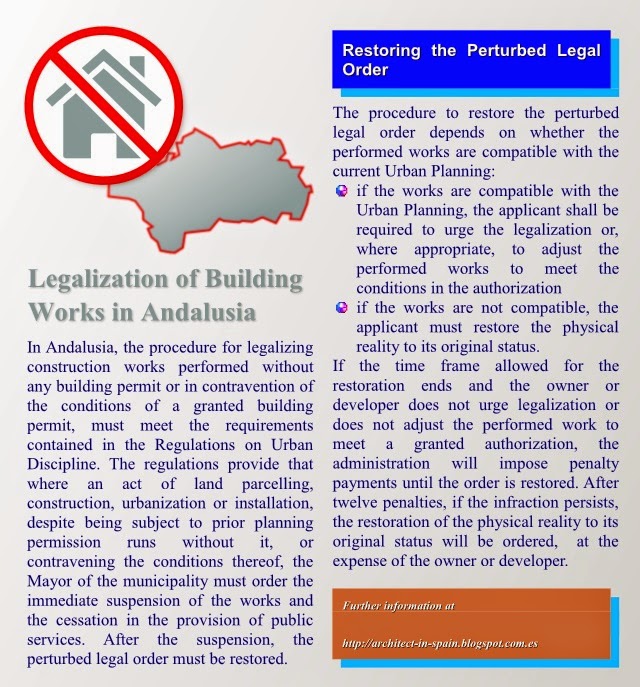
Legalization of Buildings in Andalusia (II)

Legalization of Construction Works in Andalusia (II)

Effects of the Resolution. Light Nonconformities and Non-Fulfillment.


The resolution of the legalization procedure produces the following effects:
  • if the license gets granted or, if applicable, the actions become considered consistent with their authorization, the construction works will be considered legalized
  • if the license gets denied or, if applicable, the actions become considered not consistent with their authorization, an order for restoring physical reality will be issued.

Light Nonconformities

If the replacement of physical reality is considered difficult or impossible and the non-conformities of the performed works with applicable urban planning are not substantial, it will still be possible to apply and obtain legalization, exceptionally. In order to discern whether nonconformities with urban planning are substantial or not, current Regulations on Urban Infractions in Andalusia considers the following rating criteria:
  • excess in floor area, in relation to authorized parameters
  • visibility from the street
  • affection of the performed construction works over the rest of the building complex
  • robustness of the performed works
  • affection to architectural barriers to the handicapped.

If the developer was formerly sanctioned because of serious urban planning offenses, he will not be able to benefit from the application of this principle.

Non-Fulfillment of the Legalization

If the time allowed in the process of protecting urban planning law expires and the developer does not apply for the legalization or, if applicable, does not fit the performed construction works to their authorization, the acting Public Administration will proceed according to the following cases:
  • If the legalization is possible, it will impose up to 12 coercive fines, until the legalization gets applied or, if applicable, the performed construction works get adjusted to the authorization. If, after imposing the 12th fine, the correction has not yet produced, the replacement of the physical reality will be ordered, and the developer will be forced to pay for it.
  • If the legalization is not possible, it will order the replacement of the physical reality.
  • If the performed construction works are manifestly incompatible with the urban planning, the City Council, or other public entity responsible for urban planning, will order the immediate demolition of the works, after hearing with the developer.

Legalization Procedure and Disciplinary Procedure

The appreciation of the alleged commission of an urban planning offense should always give rise to the initiation, investigation and resolution of a relevant disciplinary procedure, no matter if the legalization is possible or not. The procedure derived from the requirement for the application of the legalization of the performed construction works, or for replacing the physical reality, should be instructed and resolved regardless of the disciplinary procedure, but both procedures should be developed in a coordinated manner.
Legalization Documents for Construction Works


Architect Daniel Trujillano

Friday, 6 June 2014

Legalization of Buildings in Andalusia (I)

Legalization of Construction Works in Andalusia (I)

Legalization or Replacement. Procedure. Inspection Plans.


Between the provisions established by Decree 60/2010, about Regulation of Urban Infractions in Andalusia, are those governing the legalization of construction works performed with no license or violating the conditions in a granted license.

Legalization or Replacement

In Andalusia, if an act of urbanization, construction, or installation is subject to prior planning permission and is eventually performed without it, or against the conditions in a granted permit, the City Council shall order the immediate suspension of the works. After the suspension, the restoration of the disturbed legal order must be performed by one between the following procedures:
  • if the performed works are compatible with current urban planning, through the Legalization of the Works
  • if the performed works are not compatible with urban planning, through the Replacement of the Physical Reality to its original state.

All of the above also applies in the case of acts performed in breach of the terms of an Order by the City Council.

Procedure for the Protection of the Urban Law

If the works performed with no license, or against the conditions in a granted license, are compatible with current urban planning, the developer must be required to apply for the legalization or, where appropriate, to fit the performed works to the granted permit. If the developer chooses to legalize, he will have two months to apply for it; however, if the performance is very complex, he can apply for extend this period for two additional months.

Municipal Plans for Urban Inspections

According Andalusian Decree 60/2010, every Municipal Plan for Urban Inspections should count with an inventory containing, for each class and category of land, a relationship of buildings, settlements and other actions which must be subject to legalization, in conformity with all applicable territorial and urban planning regulations.
Legalization Projects


Architect Daniel Trujillano

Monday, 2 June 2014

Legalization Documents for Buildings in Spain (I)

The Legalization of Buildings in Spain (I)

Legalization as a Method to Restore the Perturbed Legal Order


In Spain, when construction works are performed without having a building permit or violating the conditions in a granted building permit, the legal order is considered perturbed. The right method for restoring the legal order depends on whether the performed works are or not compatible with the applicable urban planning. If the performed construction works are not compatible with the urban planning, the only way to restore the legal order will be resetting the physical reality to its original state, which will involve demolishing what has been built, but if the works are compatible with urban planning, there will be another solution: legalizing the performed works.

Deadline for Applying for Legalization

When a developer is required for legalizing construction works performed without a building permit (or violating the conditions in a granted permit) he should apply for the legalization within a specific time frame wich, in Andalusia, is two months. That time frame can be expandable in response to the complexity of the project.

After the Application

It's neccesary to keep in mind that, having applied for legalization, it's still possible that finally the demolition of what was built gets ordered. If the legalization is applied and is denied, it will be neccesary to restore the physical reality and therefore to demolish what was built. The same applies if, after applying for the legalization, the result is the legal inadmissibility of the acts, because of non-conformity with determinations in applicable legislation and urban planning.

Penalties for Non-Compliance

If after the time granted to the developer in order to legalize the construction works, he doesn't apply for the legalization, successive coercive penalties will be imposed. In Andalusia, the amount of such penalties is, each time (penalties are imposed for minimum periods of one month), ten per cent of the value of the completed building works, with a minimum of 600 euros.

Infringement Procedure

When the alleged commission of an urban planning infringement is noticed, it produces the initiation, investigation and resolution of a disciplinary proceeding. This legal procedure is instructed and resolved regardless of the procedure derived from the requirement for the legalization of the construction works, but in a coordinated manner.
Legalization of Buildings in Spain