Showing posts with label building permit. Show all posts
Showing posts with label building permit. Show all posts
Monday, 27 June 2016

Tuesday, 10 May 2016

Monday, 5 January 2015

Monday, 22 December 2014
Legalization and Occupation in Andalusia (I)
The Occupation of Legalized Buildings in Andalusia (I)
Legalization Projects and Occupation Licenses
In Andalusia, when the building works finish, whether with a granted building permit or not, upon completion it will be necessary to obtain an administrative approval for the occupancy and/or utilization, bound for the intended use of the building. Such approval will be formalized by an Occupation License if the building use is residential, and by an Utilization License in the case of any other building use.
Occupation or Utilization License for Buildings with a Building Permit
If the building works are performed counting with a granted building permit, the granting of the Occupation or Utilization License will require to verify that the finished works comply with the terms of the building permit, so it will be necessary to submit the following documents:
- a Statement about the Conformity of the works with the Construction Documents
- documents attesting the functionality of the installations
- the Final Performance Certificate, attesting the completion of the works.
If it turns out that the performed works don't comply with the terms of the granted building permit, the granting of the Occupation or Utilization License will require the prior (or simultaneous) legalization of the performed works, or the replacement of the altered physical reality.
Occupation or Utilization License for Buildings without a Building Permit
The legalization of building works performed without a building permit or breaking the conditions of a granted building permit, restores the disturbed legal order, for the sake of its substitute character of the building permit, but it does not provide for itself the licensing of the occupation or utilization, which will have to be the subject of further administrative actions. In fact, the legalization of a building does not even require that the works are completed, contrary to what happens with the occupation. The application of an Occupation or Utilization License is also required for completed buildings recognized in Situation of Assimilated to Outside Planning (SAFO).
Compliance with Urban Planning
The verification of the compliance with the Urban Planning regulations is not an attribution of the Occupation or Utilization License, but obtaining an Occupation or Utilization License for completed parties which are technically and functionally independent of the rest requires that these parties comply with the Urban Planning regulations and that the rest of the building shows no significant disagreements.

Architect Daniel Trujillano
Legalization Projects for Building Works in Andalusia
Monday, 15 December 2014
Limitation Periods for Urban Offenses in Andalusia
Time Limits for Urban Offenses in Andalusia
Rules for the Legalization of Illegal Buildings
In Andalusia, the Urban Discipline Regulations (RDUA) and the Andalusian Law on Urban Planning (LOUA) establish the following limitation periods for urban offenses:
- for important and major offenses: 4 years
- for minor offenses: 1 year.
Such limitation periods represent the timeframe within disciplinary proceedings can begin, although for the adoption of measures for the reinstatement of the disturbed civil order, either by legalizing the works or by replacement of the altered physical reality (demolition), the timeframe is 6 years since the full completion of the works.
Illegal Constructions with Prescribed Urban Offense
The type of procedure applicable to the buildings performed without building permit or violating the conditions of a granted permit, in which the urban infraction is already prescribed will depend on the situation:
- if the performed works are clearly in disagreement with the urban planning it will be necessary to obtain the recognition of Situation Assimilated to Outside Planning regime (SAFO)
- if the performed works are in conformity with the urban planning and they are completed, its occupation and use, and also the performance of any works on them, will require the recognition or accreditation that the works are in situation of urban conformity, and the legalization will be automatically granted by prescription.
If the performed works are in conformity with the urban planning but they are still not completed, the urban offense cannot be considered prescribed, so the legalization will be mandatory.
Rules for the Legalization of Building Works in Andalusia
The legalization of building works performed without building permit, or violating the conditions of a granted permit, is subject to the same documentary, procedural and adjudicative rules that apply for obtaining a building permit. In other words, the legalization of building works is proposed as an equivalent substitute for the building permit. The current urban legislation in Andalusia (LOUA and RDUA) does not specify the required documentary content for the Legalization Projects, but in establishing that the rules for the application are the same as for building permits it suggests that the documents needed shall be equivalent to the Construction Documents established by the RDUA for the processing of building permits.
Architect Daniel Trujillano
Legalization Documents for Buildings in Andalusia
Wednesday, 3 December 2014
Legalization of Buildings on Undevelopable Land
Legalization Projects on Undevelopable Land
Communication. License. Settlements on Undevelopable Land. Inspection Plans.
Andalusian Decree 2/2012 establishes the regime of buildings and settlements on Undevelopable Land in Andalusia.
Administrative Communication
Among the detached buildings on Undevelopable Land, Andalusian Decree 2/2012 differentiates the buildings that conform to the current Urban and Territorial Planning, and within that classification, it differentiates the buildings that have been built without any Building Permit or violating the conditions of a granted Building Permit. For such buildings, the Decree provides that the City Council should notify the owner about the opportunity to formalize the legalization.
License and Legalization in Andalusia
Notwithstanding the administrative requirement of legalization, the owner should always apply for the License, according to the procedure described in the Andalusian Law on Urban Planning (LOUA) and the Urban Discipline Regulations.
Urban Settlements in Undevelopable Land
The legalization of completed buildings belonging to urban settlements in Undevelopable Land requires the following circumstances:
- they must comply with the Urban Planning
- the urban infrastructure must be endorsed by the City Council
- all legal obligations established by the LOUA must be fulfilled.
If the buildings are still under construction, the legalization will also require:
- all urban infrastructure works should be previously performed, or
- all requirements imposed by the LOUA for the simultaneous development of infrastructure works and building works should be fulfilled.
Municipal Plans of Urban Inspection
Among all the documents required by the Urban Discipline Regulations for the Municipal Plans of Urban Inspection there must be an inventory including an identification of all the buildings, settlements, subdivisions and other actions that should be included in a legalization process, according to the applicable Territorial and Urban Planning, for each class and category of the land.

Architect Daniel Trujillano
Legalization Documents for Building Works in Andalusia
Monday, 24 November 2014
Sunday, 23 November 2014
Friday, 21 November 2014
Monday, 2 June 2014
Legalization Documents for Buildings in Spain (I)
The Legalization of Buildings in Spain (I)
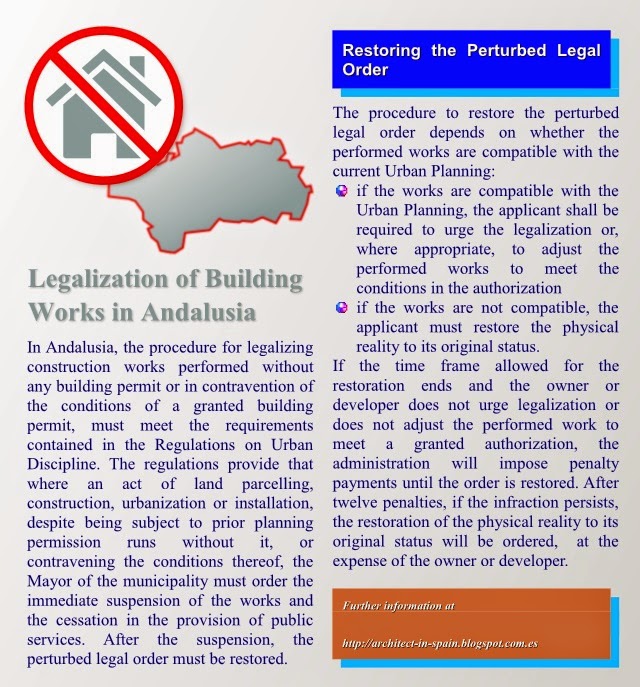
Legalization as a Method to Restore the Perturbed Legal Order
In Spain, when construction works are performed without having a building permit or violating the conditions in a granted building permit, the legal order is considered perturbed. The right method for restoring the legal order depends on whether the performed works are or not compatible with the applicable urban planning. If the performed construction works are not compatible with the urban planning, the only way to restore the legal order will be resetting the physical reality to its original state, which will involve demolishing what has been built, but if the works are compatible with urban planning, there will be another solution: legalizing the performed works.
Deadline for Applying for Legalization
When a developer is required for legalizing construction works performed without a building permit (or violating the conditions in a granted permit) he should apply for the legalization within a specific time frame wich, in Andalusia, is two months. That time frame can be expandable in response to the complexity of the project.
After the Application
It's neccesary to keep in mind that, having applied for legalization, it's still possible that finally the demolition of what was built gets ordered. If the legalization is applied and is denied, it will be neccesary to restore the physical reality and therefore to demolish what was built. The same applies if, after applying for the legalization, the result is the legal inadmissibility of the acts, because of non-conformity with determinations in applicable legislation and urban planning.
Penalties for Non-Compliance
If after the time granted to the developer in order to legalize the construction works, he doesn't apply for the legalization, successive coercive penalties will be imposed. In Andalusia, the amount of such penalties is, each time (penalties are imposed for minimum periods of one month), ten per cent of the value of the completed building works, with a minimum of 600 euros.
Infringement Procedure
When the alleged commission of an urban planning infringement is noticed, it produces the initiation, investigation and resolution of a disciplinary proceeding. This legal procedure is instructed and resolved regardless of the procedure derived from the requirement for the legalization of the construction works, but in a coordinated manner.

Subscribe to:
Posts (Atom)