Showing posts with label property registry. Show all posts

Tuesday, 30 December 2014

Rules for the Valuation of Properties According ECO/805/2003 (IV)

Valuation Rules According ECO/805/2003 (IV)

Floor Areas used in the Valuation of a Property


In general, the floor area that must be used in order to calculate the value of a building in Spain is the floor area as checked by the valuer. However, the particular circumstances of a building may require using other floor areas:
  • if it's not possible to check the floor area on-site, the area to use will be the lowest between the floor areas considered by the Cadastre and the Property Registry
  • if it was possible only to check the Gross Floor Area or the Gross Internal Area without the floor area of the common parts, due to operational difficulties involved in checking all the floor area of the common parts, the area to use will also be the lowest one between the cadastral floor area and registry floor area with common parts, provided that the valuer considers that the proportion between the floor area finally used and the checked one is reasonable
  • if the checked floor area of a building exceeds by more than 5 percent to the registry floor area or to the cadastral floor area, the adoption of the checked floor area will require to verify the adequacy to the applicable urban planning regulations
  • if the checked floor area of an element of a building exceeds by more than 10 percent to the registry floor area or the cadastral floor area, the adoption of the checked floor area will require to verify the adequacy to the urban planning regulations
  • if the building lacks of Statement of New Building entered in the Property Registry, the adoption of the checked floor area will also require to verify the adequacy to the urban planning regulations
  • if the floor area of the private outdoor spaces for the exclusive use of the building exceeds by more than 15 percent of the total floor area thereof, the floor area of the outdoor spaces shall be measured separately and valued with a different unit price
  • in the valuation of homes subject to public protection, for the purposes of calculating their maximum legal value, the floor area that should be adopted is the one contained in the Certificate of Qualification.

Valuation of Buildings in Spain


Architect Daniel Trujillano

Wednesday, 10 December 2014

Buildings Assimilated to the Outside Planning Regime (II)

Properties Assimilated to the Outside Planning Regime (II)

Technical Certificate for Particularized Recognition


The particularized recognition of a building assimilated to the outside planning regime provides a valid document for the definitive hiring of the services provided by the suppliers of electricity, water, gas and telecommunications. It also allows access to the Property Registry for the recognized building, by the inscription with notice about its particularized situation. After obtaining recognition, all repair and maintenance works required by the strict preservation of the safety and health conditions of the building will be authorized.

The Technical Certificate

Normally, the inscription in Title Deeds of buildings performed under the prescription of an urban infraction will require a technical certificate stating about the description and the antiquity of the performed works. However, to obtain the resolution of building assimilated to the outside planning regime, such certificate should contain:
  • complete identification of the affected property, indicating the number in the Property Registry (if it's already registered) and geographic location by cadastral reference
  • date of completion of the building, properly accredited by any valid evidence document
  • the use to which the property is intended
  • expert opinion about safety, habitability and health conditions, considering the building use
  • expert opinion about the installations, considering the autonomous character, the environmental sustainability and the current regulations, and considering the building use
  • if the building lacks of some installation, a description of all necessary works needed for the provision of every basic service required.

In other words, the procedure for the recognition of building assimilated to the outside planning situation requires drafting a set of technical construction documents, and not just a certificate of antiquity.
Legalization Projects for Buildings


Architect Daniel Trujillano
http://www.arquitectotrujillano.com/legalization/home.html
Legalization Documents for Buildings in Andalusia

Thursday, 21 February 2013

Antiquity Certificates (I)


Certificates Attesting the Antiquity of Buildings (I)

Prescription Time Frame. Property Registration.


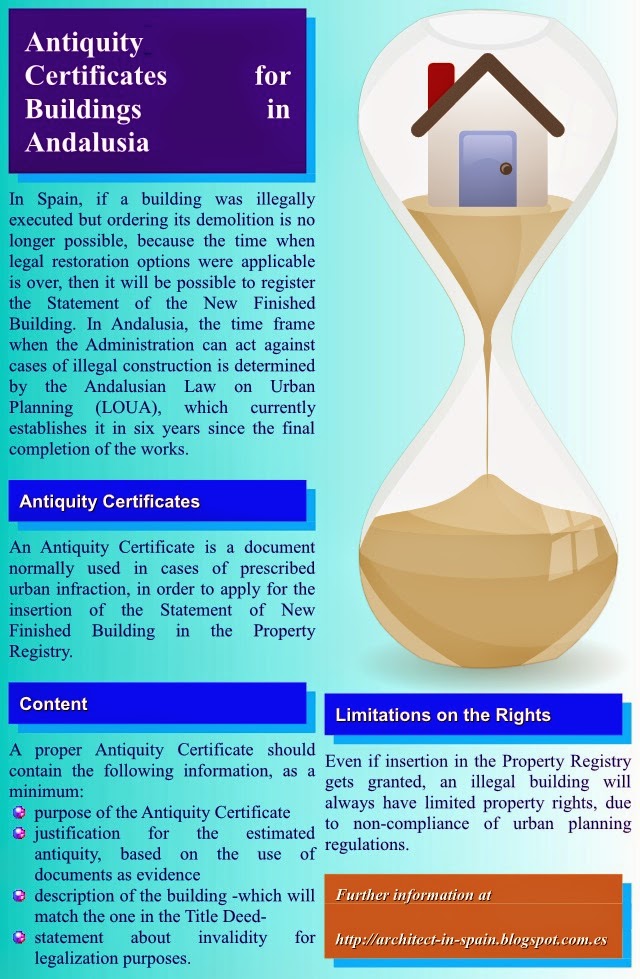
According to the Revised Text of the Spanish 'Ley del Suelo', if a construction, building or facility was illegally built but the time frame in which it was legally possible to adopt restoring actions which could implied demolition is finished, then it will be possible to declare the completed construction.

Time Frame for Restoring Actions

The applicable time frame in which the Administration may act against illegal constructions by ordering demolition is determined by regional legislation. In Andalusia, this legislation is contained in the Law on Urban Planning of Andalusia (LOUA), which currently sets the time frame in six years after the full completion of the works. The prescription time frame is not applicable in the following types of location:
  • undeveloped land with special protection
  • land located in the Coastal Influence Zone
  • Catalogued Land
  • parks, gardens, open spaces or infraestructure
  • allocations reservations.

In all locations listed, the action of the Administration does not prescribe at all.

Property Registration

Among the documents which can be used to enter a new Title Deed in the Register of the Property are the certificates issued by competent technicians, stating the completion of works on specified date along with a building description which must match the one set forth in the Deed. This kind of documents are known as "Antiquity Certificates", which must be written by registered Architects and used to apply for registration.

Checking for Registration

At the time of registration, in addition to receiving the Antiquity Certificate, the Registrar must verify:
  • the lack of notation for initiation of urban discipline actions
  • the location is non demanial or affected by public easements.

Also, if the construction, building or facility is in an “out of urban planning” situation, in accordance with applicable urban planning, the Registrar must notify the registration to the City Council.
Antiquity Certificates for Buildings in Spain


Daniel Trujillano, Architect
Antiquity Certificates for Buildings and Constructions in Andalusia