Showing posts with label antiquity certificate. Show all posts
Showing posts with label antiquity certificate. Show all posts
Monday, 5 May 2014

Wednesday, 23 April 2014
Wednesday, 9 April 2014

Monday, 4 March 2013
Antiquity Certificates (III)
Certificates Attesting the Antiquity of Buildings (III)
Justification of Antiquity. Purpose, Limitations and Approval.
Antiquity Certificates of buildings and constructions must contain justification for the estimation of the age, which must be based on the use of documents as evidence. These documents must be provided together with the certificate.
Supporting Documents
List of documents which serve as a reference to establish the age of a building property:
- dated aerial photographs, obtained from sources such as 'Ministerio de agricultura, pesca y alimentación', 'Consejería de vivienda y ordenación del territorio' or 'Consejería de agricultura y pesca de la Junta de Andalucía'
- documentation belonging to urban planning, in which the building is clearly rendered
- contracts for supplies, like water, electricity or telecommunications
- cadastral certifications.
Purpose and Limitations of the Antiquity Certificates
Ideally, the text of the Antiquity Certificate must specify the purpose for which it is drawn. Antiquity Certificates should never include aspects related to the habitability or structural safety of the building; these are typical aspects of the Final Certificates that are part of the Legalization Projects. Therefore, Antiquity Certificates are not proper documents that may grant particularized recognition of a situation assimilated to 'out of urban planning' regime. It is appropriate that the certificate text expressly states that it is not a valid document for the purpose of legalizing the property, in order to avoid confusion about the scope.
Approval by College of Architecture
In accordance with Spanish Royal Decree 1000/2010, Antiquity Certificates do not require the approval by the College of Architecture, because there's not a direct causal link between the professional work of the architect and the effect on the physical integrity and security of the people.

Drafting of Antiquity Certificates for Buildings in Spain
Tuesday, 26 February 2013
Antiquity Certificates (II)
Certificates Attesting the Antiquity of Buildings (II)
Documents and Accreditations. Limitations on Property Rights.
Besides the Antiquity Certificate, if the primary use of the illegal building is residential, the act of registration by prescription of urban infraction requires accreditation of the decennial insurance constitution, unless some of the following circumstances:
- the property is a dwelling developed by the owner, although the obligation for the constitution of the insurance reborns if the building is sold within ten years from the completion of the works and the acquirer does not expressly exempt that constitution
- the time elapsed since the accredited date of the end of the works exceeds ten years.
Instead, in these cases it's not neccesary to furnish the following documents:
- Building permit
- First Occupation permit
- 'Book of the building' accreditation.
As for the administrative act about the possible declaration of 'out of urban planning' situation, Spanish General Directorate of Registries and Notaries interprets it's not a prerequisite for the registration, but it can be performed later.
Limitations on Property Rights
In Spain, when a building has somehow violated the applicable planning regulations, although its property registry may be allowed, it will always have limited property rights, since it will probably not be able to get permission for reforms, rehabilitations or improvements. Thus, Notaries and Registrars are required to collaborate so that in the event of transfer by deed of buildings declared under prescription, the third party is aware of what he is really buying. Consequently, Registry Notes should indicate whether the registered building was declared under prescribed administrative action, and deeds must disclose whether the property is in an 'out of urban planning' or assimilated situation.

Daniel Trujillano, Architect
Antiquity Certificates for Buildings in Spain
Thursday, 21 February 2013
Antiquity Certificates (I)
Certificates Attesting the Antiquity of Buildings (I)
Prescription Time Frame. Property Registration.
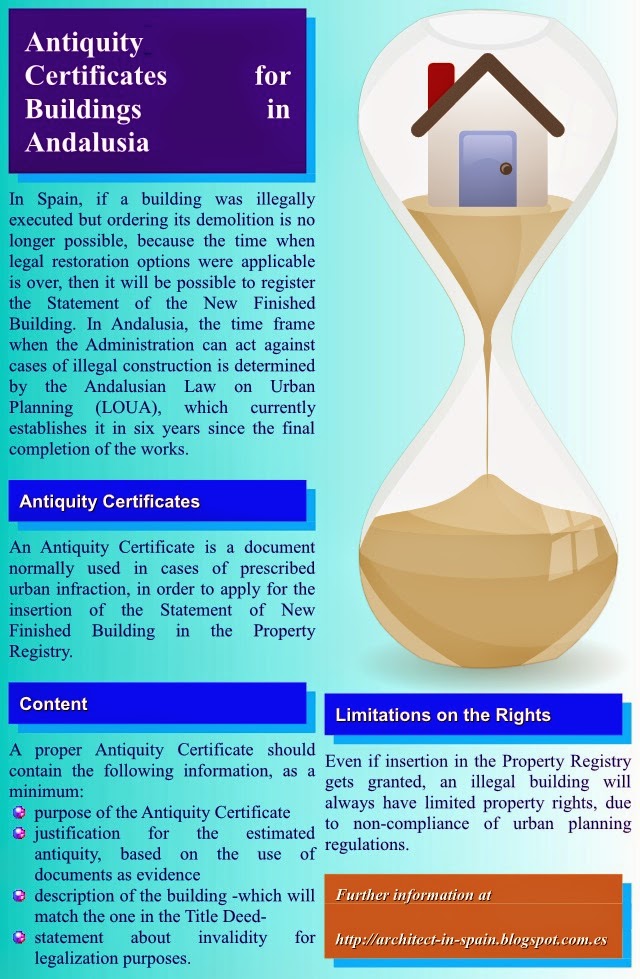
According to the Revised Text of the Spanish 'Ley del Suelo', if a construction, building or facility was illegally built but the time frame in which it was legally possible to adopt restoring actions which could implied demolition is finished, then it will be possible to declare the completed construction.
Time Frame for Restoring Actions
The applicable time frame in which the Administration may act against illegal constructions by ordering demolition is determined by regional legislation. In Andalusia, this legislation is contained in the Law on Urban Planning of Andalusia (LOUA), which currently sets the time frame in six years after the full completion of the works. The prescription time frame is not applicable in the following types of location:
- undeveloped land with special protection
- land located in the Coastal Influence Zone
- Catalogued Land
- parks, gardens, open spaces or infraestructure
- allocations reservations.
In all locations listed, the action of the Administration does not prescribe at all.
Property Registration
Among the documents which can be used to enter a new Title Deed in the Register of the Property are the certificates issued by competent technicians, stating the completion of works on specified date along with a building description which must match the one set forth in the Deed. This kind of documents are known as "Antiquity Certificates", which must be written by registered Architects and used to apply for registration.
Checking for Registration
At the time of registration, in addition to receiving the Antiquity Certificate, the Registrar must verify:
- the lack of notation for initiation of urban discipline actions
- the location is non demanial or affected by public easements.
Also, if the construction, building or facility is in an “out of urban planning” situation, in accordance with applicable urban planning, the Registrar must notify the registration to the City Council.
Daniel Trujillano, Architect
Antiquity Certificates for Buildings and Constructions in Andalusia
Subscribe to:
Posts (Atom)